Shaggy Ink Cap Mushroom Study Art Print, vintage botanical illustration, woodland decor, study wall art, nature lover gift
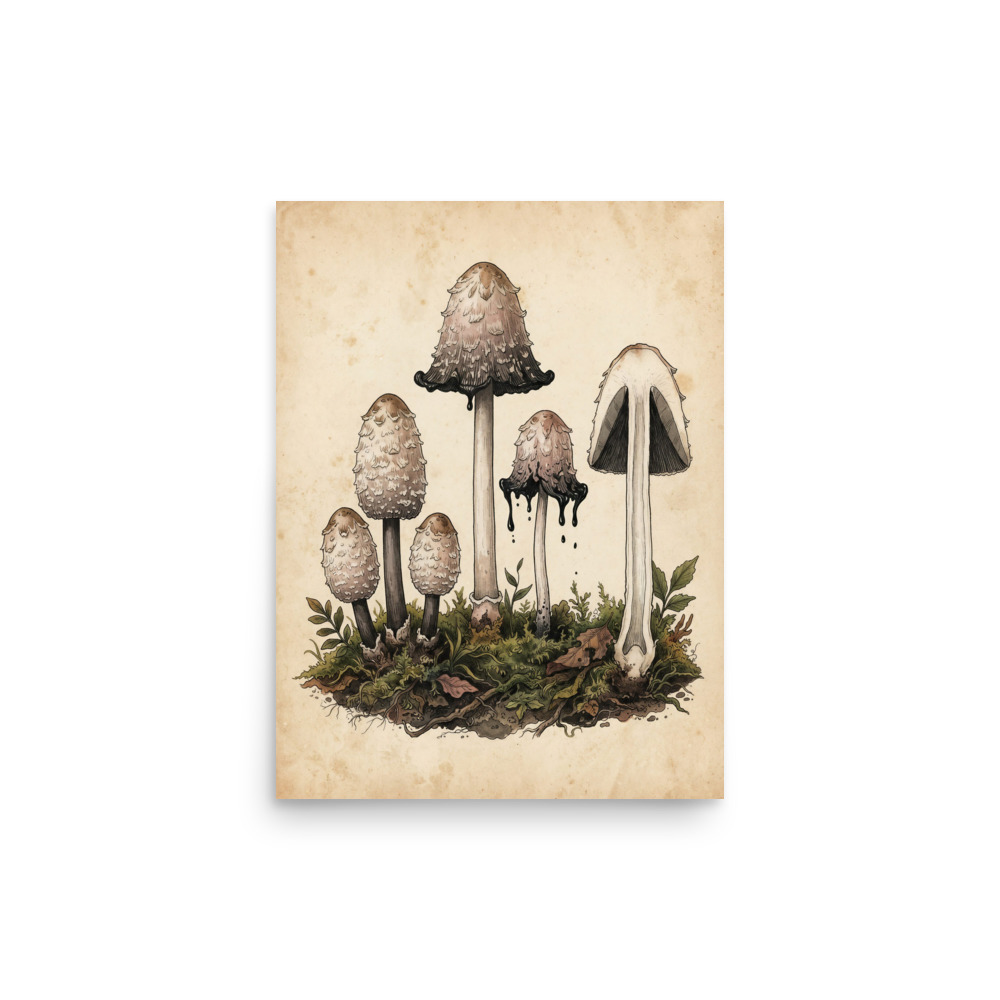
Shaggy Ink Cap mushrooms unfold across a continuous mossy forest floor, rooted together and shown at several growth stages, with one specimen sectioned to reveal its gills and stipe. Fine ink linework and soft gouache colour create an antique field guide look on Enhanced Matte Paper (189 g/m²), with umber, moss green, ochre and dusty rose tones—an atmospheric art print for a study or nature-loving gift.
The eye meets a low, continuous woodland floor before it settles on any single mushroom. Shaggy Ink Caps rise from the moss in a loose spread, their pale, tapering forms appearing at different stages of growth: some closed and upright, some opening, and one shown in section so the fine gills inside the cap and the structure of the stipe can be seen. The composition keeps the fungi connected to their setting rather than isolating them as separate specimens. Moss green and umber establish the ground, while ochre warms the stems and surrounding earth. Dusty rose brings a muted note to the mushroom caps and softens the darker forest tones. Fine ink lines describe the ridges, edges and delicate changes in texture, while restrained gouache washes settle colour into the forms without covering the drawn detail. The result has the measured look of a plate made for close looking, with enough variation in scale and position to lead the eye from the sectioned specimen to the smaller growths nearby.
Its style belongs to the tradition of antique botanical and natural-history field guides, where a plant or fungus was presented as both a subject of study and an image to be observed closely. The concrete marker here is the combination of precise ink contours with quiet, hand-painted colour: the line carries the information, while the washes distinguish the moss, cap, gills and stem. Rather than using a broad, modern graphic treatment, the artwork relies on small changes in pressure, contour and tone to describe each stage of the mushrooms’ development. The sectioned example gives the composition the practical character of a study sheet, allowing the outer form and inner structure to appear together. Its restrained palette also recalls aged woodland plates and naturalist illustrations, without turning the scene into a literal diagram. The darker umber marks anchor the image, moss green spreads across the floor, ochre picks out the warmer parts of the stems, and dusty rose gives the caps a subdued, organic variation. It suits a room where books, collected objects and natural materials already have a place.
On a wall, the print works well above a writing desk, beside a bookcase, or in a quiet corner with a wooden frame. Its horizontal forest-floor composition gives it a grounded presence, while the repeated vertical stems keep the image from feeling flat. A warm white, cream or pale mushroom-coloured wall will sit naturally with the umber and ochre, while a deep green or blue-grey wall will draw out the moss and make the lighter mushrooms more distinct. The artwork wants gentle, directional light rather than a hard spotlight. Morning light from a nearby window can bring forward the thin ink lines and the variations between the different specimens; softer afternoon or lamplight will emphasise the mossy greens and dusty rose. In a study, reading nook or bedroom, it adds a close-up view of the forest floor without overwhelming the surrounding furniture. It also makes a considered gift for someone who keeps field guides, notices fungi on woodland walks, or prefers nature imagery with visible drawing and surface detail.
| Material | Enhanced Matte Paper (189 g/m²) |
| Digital printing | |
| Care | Frame or mount out of direct sunlight; wipe gently with a dry, soft cloth. |
| Shipping | Made to order — ships in 2–5 business days |